
Just two days after health officials declared two critical COVID-19 patients “virus free,†a 35-year-old Thai man on March 1 became the kingdom’s first coronavirus-linked fatality.
Yet, prior to that, no Thai man of that age and serious condition had been mentioned in the briefings that are the public’s only source of information. When his death was disclosed, official claims that he also had dengue fever were publicly disputed as false by a top hospital disease expert. It wasn’t the first time the Health Ministry appeared to withhold information or cloud it with ambiguity.
When an infection cluster of 11 people in Bangkok was announced yesterday, Health Permanent Secretary Sukhum Karnchanapimai said they were likely infected late February by a tourist from Hong Kong, and that some started getting sick from March 4, more than a week before the news was made public. As has become routine, when pressed for details by reporters, the authorities declined to identify where the group had been “partying.â€
Then there are all the lesser discrepancies that have piled up. They range from delays in announcing cases, airport invitations to see body heat scanners officially “not in use†before being declared “there all along,†and overly bold assurances that had to be walked back.
They fly in the face of the advice of the World Health Organization, which has long considered transparent, timely and reliable public information critical to combating health threats.
“Pro-active communication, as one example, allows the public to adopt protective behaviours, facilitates heightened disease surveillance, reduces confusion and allows for a better use of resources, all of which are necessary for an effective response,†it concluded in of the 2003 SARS outbreak. It blamed bad government info for spreading the virus and credited improved public awareness for later bringing it under control.
Certainly, during an emergent health crisis, genuine mistakes and miscommunication are to be expected. But taken altogether, Thailand’s pattern of misstatements, contradictions and self-serving revisions suggest that a desire to sugarcoat the situation has taken precedence over “pro-active communication.â€
It inevitably has contributed to a collapse in confidence that those tasked with safeguarding the public are telling the truth, and growing distrust of the government’s uncoordinated response is likely to further hamper its efforts.
As the government initiates prosecution of those trafficking in rumors, its very attempts to control the message seem to be feeding them.
To date, the health ministry has refused to disclose where infected patients have visited or likely were exposed, as Singapore . They cite privacy and fear of mass panic, but end up provoking the opposite effect – intensifying online rumors. Just yesterday, netizens were declaring numerous Thonglor venues as “infected†and to be avoided, sometimes with little or no evidence.
Further eroding trust is the bravado of overconfident assurances compared to the measured uncertainty expressed by health officials elsewhere.
Just yesterday, Perm-Sec Sukhum announced that the authorities have been able to detect “100%†of all cases.
Thai officials also insist the virus is barely spreading within the kingdom despite at least four foreign travelers – an Australian, Indian, South Korean and German – testing positive upon their return home.
‘Tip of the Iceberg’
Narin Hiransuthikul, expert in epidemiology at Chulalongkorn University, said that while he’s quite certain the authorities aren’t hiding any infected patients, he fears the official number – 75 as of Friday – is just “the tip of an iceberg.â€
“There could be many more cases we didn’t find. It’s those who’re asymptomatic,†he said by phone Tuesday, referring to the fact that show little to no symptoms and may not know they are ill. “There’s a high possibility that these people don’t have access to our screening process, because the criteria by the ministry is quite strict. You must have symptoms or [evidence of] exposures, otherwise you won’t be tested.â€
The Health Ministry has warned people against getting tested if they don’t have symptoms to ease the burden on healthcare workers who were already struggling before the outbreak. People who don’t fit the criteria must pay for their own tests, which, depending on where one goes, can range from a few thousand baht to as high as THB20,000 (US$630).
Health spokesman Rungrueng Kitphati acknowledged there’s a possibility that some asymptomatic cases could go undetected. However, he made clear his belief those are “the minority†of cases.
“Our detection system is considered one of the world’s tops,†he said by phone Thursday. “There’s no need for us to perform mass testing. Those who don’t have symptoms don’t need to get tested.â€
He said the transmission potential of asymptomatic cases is very low, and there have been very few cases of those spreading it to others. He also said the ministry has already expanded the screening criteria to those with pneumonia of unknown cause, people with flu-like symptoms in an outbreak cluster, and any healthcare workers who fall ill.
Chula’s Narin nonetheless said that for control measures to be effective, it shouldn’t be assumed that those without symptoms won’t transmit the virus. He said the most worrisome scenario is “invisible†spreaders infecting more vulnerable people, especially during the looming Songkran holiday, which has the potential to be the next phase of disaster.
“If what we’ve understood is correct, people who are infected but don’t manifest symptoms can transmit it. When they go travel or visit their hometown or see their elders during Songkran without knowing they have it   the situation will become very dire,†he said.
Rungreung told șÚÁÏÉç Bangkok that the ministry is already in the process of preparing measures to prevent the situation from getting worse during the nation’s busiest travel season next month but declined to elaborate, saying they had yet to be approved.
So how many undetected cases could there be?
A Harvard Department of Epidemiology from Feb 4 said Thailand likely has many more unreported cases. Researchers compared the amount of air travel between different nations and Wuhan, China, the original outbreak zone compared to the number of reported cases and found that the kingdom likely had unreported cases alongside Indonesia and Cambodia, two nations which also went weeks without reporting any infections until mushrooming recently.
It found that while Thailand had reported several cases at the time, it had more than double the air traffic from the Chinese city and therefore likely to have many more cases.
Travel Clusterfudge
While Thai health authorities may very well be disclosing each known case, there have been times, as with the latest cluster of 11, when disclosure of new cases was delayed for days.
A 73-year-old woman and the first Thai to be infected was announced Jan. 22. She revealed in later interviews that she got her results three days earlier on Jan. 19. A taxi driver was announced as the first local transmission on Jan. 31. It came out at a Feb. 5 presser that he tested positive two days earlier on Jan. 28.
Health Ministry’s Rungrueng said the delay was due to a desire to verify the results as accurately as possible.
“Lab results can show false positives,†he said. “When someone tests positive, we need to retest [multiple times] before we’re confident enough to announce it.â€
As transparency remains in doubt, public confidence isn’t helped by a government response that has been extremely erratic and uncertain, at times feeding fears rather than easing them.
Pichate Yingkiattikun, an office worker in Bangkok, came back from Japan on March 1 and is now in voluntary 14-day self-quarantine. In a phone interview Monday, he said the screening process at Don Mueang Airport seemed stricter than usual, and he saw a couple of people led away by airport staff after a thermal scanner detected fever.
But he felt uneasy about how immigration interviewed foreign tourists, especially one “ill-looking†Chinese man.
“He was wearing a mask and was coughing,†Pichate said. “They spoke in English, but the problem was the officer couldn’t speak English very well, and the Chinese man also couldn’t. I feel like, before we think about whether tourists speak the truth or not, can they even communicate properly?â€
Thailand, a major tourism hub, welcomed nearly 40 million foreign tourists last year, of which more than 10 million were Chinese.
While Pichate was in Japan, anger was simmering back home over inaction to limit the influx of global travelers. It wasn’t until Wednesday that the government announced it would suspend visa-waivers and visas on arrival for more than 20 nations, affecting travel from Hong Kong, South Korea, Italy and many more.
Thai diplomatic missions in places like Hong Kong and were quick to dispute the order, posting contradictory notices that it would have no effect.
Many countries on the list – like Nauru, tiny Vanuatu and Fiji – had no reported infections.
But it turned out to be a short-lived, confusing distraction. In a U-turn, Consular Affairs’ Chatri Archjananun told reporters one day later the measure was “on hold†until it got cabinet review.
And just hours later, Interior Minister Anupong Paochinda, made another about face by issuing a statement saying it would take effect today and be in place through September.
It followed a series of similar policy-making debacles and botched communication that sent waves of confusion across the country and outside its borders.
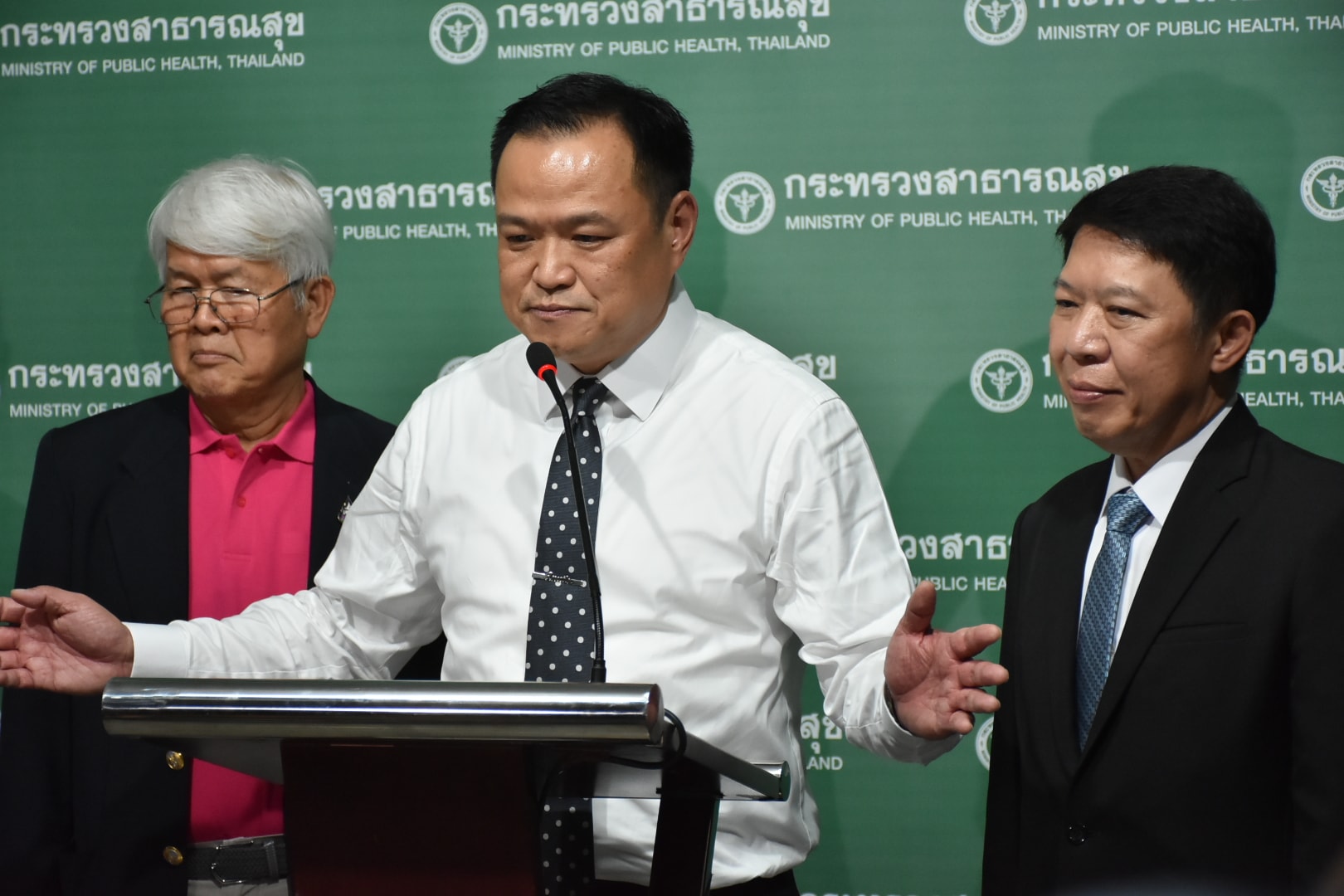
And we haven’t even mentioned the gobsmackers presented by the increasingly bizarre and kind of racist health minister.
Anutin Charnvirakul, the public face of the government response, denied issuing a self-quarantine travel order posted to his own Facebook account that had his signature affixed. It unilaterally declared that people from 11 places – including Taiwan, Singapore, Japan, Germany and France – must enter 14-day quarantine “without any exception.â€
After roiling regional travel, the order quickly vanished – along with his entire Facebook account. A revised version came out two days later with notably fewer nations. Anutin later flatly denied he had anything to do with the post and denied signing it.
‘Too Weak’
Narin, Chulalongkorn University’s vice president, said he thinks enforcing regulations on just six territories after the disease has spread to all corners of the globe is simply inadequate. He’s also not confident in the government’s screening methods.
“There’s a very high chance that we’ll be sloppy, and will definitely miss imported cases,†he said. “For example, catching it with a thermal scanner is very imprecise. There’s a chance it will miss like 80-to-90 percent of the cases. The Health Ministry’s screening standards are too weak.â€
Of the millions thus screened at airports, only 219 suspected cases had been detected at Thailand’s ports of entry as of Thursday, according to the Health Ministry. The majority of cases have been detected by sick people who went to get themselves tested at hospitals.
Strict measures were enacted on Thai workers returned from virus-stricken South Korea, and clearly state anyone traveling from those six areas must enter self-quarantine. However, a German journalist who recently went on a reporting trip in Daegu, the major outbreak zone there, said Tuesday there was “no word about quarantine†when he arrived in Thailand on Sunday – three days after the regulations supposedly had taken effect.
“I do it anyways because I take it serious, but nobody told me to,†said the journalist, who asked not to be named. He said he spent about 45 minutes at the health control at airport, which checked his temperature, then required him to fill his address and contact information into a form.
A day later, a Yangon-based designer who had an overnight layover on her way back home from Hong Kong said she walked out of Don Mueang Airport for a nearby hotel without any additional measures beyond being asked to complete an extra health form that included checkboxes for symptoms.
McKenna Kemp said she did her best to stay abreast of the confusing, ever-changing announcements prior to her flight, but when she landed Monday night at Don Mueang Airport, there was nothing more than a body heat scanner and staff who scanned the health form.
Facing accusations that they were reluctant to impose stricter rules for foreigners, Sopon Iamsirithawon of the Communicable Disease Division said Wednesday that Thai people carrying the disease from abroad have more potential to cause a wider outbreak. However, epidemiologist Narin said letting foreigners come in without a proper regulation was more worrying.
Pichate, who went to Japan, said he felt it was unfair that he put the effort into isolating himself, while other non-Thais continued to flood in without being required to do the same.
“The problem is we’re more serious with Thai people coming back than other people coming in,†he said. “It’s quite discouraging, like, do I really have to do it then?â€
He also brought up the three ministers and MP from the ruling coalition Palang Pracharath Party who returned from Japan without needing to quarantine.
“Are they some sort of a special species that have a stronger immune system than me?   There’re so many exceptions. Even in health issues that should be a top priority, there are exceptions.†he said. “The enforcement is not by the same standard, and it’s also not strict.â€
Chulalongkorn’s Narin echoed similar concerns. He said the authorities’ response to this outbreak appears “too mild.â€
“The government keeps saying that we have a low number of infected patients, but the miss here is that their preventative measures are not strict enough,†he said. “Many things are still unclear. Even the quarantine enforcement doesn’t seem to be that serious.â€
He urged the government to be more swift in response and be more clear in how they communicate with the public.
“From an epidemiologist’s perspective, we should always assume the worst, so that we’ll be able to prevent it from happening,†he added. “If we keep being optimistic, we won’t be able to handle it in time.â€


